

Including Digital Assets in Your Illinois Estate Plan: A Comprehensive Guide to Digital Estate Planning
Digital assets are the intangible property you create, control, or hold online—ranging from email accounts and social media profiles to cryptocurrency wallets and NFTs—and including them in your Illinois estate plan ensures legal access, value preservation, and privacy protection. Illinois-specific law, particularly the state’s implementation of RUFADAA and recent statutory updates, shapes how fiduciaries can obtain access to these assets, so planning with state rules in mind reduces the risk of locked accounts or lost value. This guide explains what digital assets are, why Illinois law matters for access and transfer, and practical steps—inventorying assets, appointing a digital executor, updating wills, trusts, and powers of attorney—to protect digital property. You will learn how custodial differences affect transferability, what documentation fiduciaries typically need, and how to handle high-risk items like private keys and metaverse assets. The article also compares asset types, provides checklists and EAV tables to map actions to asset attributes, and outlines how an estate planning attorney can assist in Illinois. Read on for step-by-step actions, statutory clarity about Illinois RUFADAA, tax and POA implications, and how to engage professional help for tailored digital estate planning.
What Are Digital Assets and Why Include Them in Your Illinois Estate Plan?
Digital assets are intangible estate assets stored or recorded in electronic form that have legal significance or economic value, and including them in an Illinois estate plan clarifies access and transfer mechanisms. These assets function as property through usernames, passwords, private keys, or custodial relationships with platforms and financial services; recognizing how access is granted or restricted is critical to preserving value and honoring privacy. Planning prevents scenarios where executors cannot access accounts, where platform terms of service block transfers, or where heirs lose sentimental content. The following bullets highlight the top practical reasons to include digital assets in a will, trust, or power of attorney under Illinois rules.
Digital estate planning in Illinois matters because the law defines fiduciary powers, provider disclosure limits, and the interplay with user agreements, so clear directives in estate documents align expectations with statutory procedures and platform realities. This foundation sets up the specific asset categories to consider next.
Digital assets fall into several practical categories to consider for estate planning:
- Access and continuity: assets you need executors to access for administration.
- Monetary value: assets with direct financial value or that generate income.
- Sentimental or intellectual property: content with emotional or proprietary importance.
H3: Which Types of Digital Assets Should You Consider?
Digital assets include a broad range of hyponyms such as email accounts, social media accounts, cryptocurrency wallets, NFTs, cloud storage, domain names, digital photos, and online business accounts; each type raises distinct access and transfer issues. Financial-focused assets like online banking, investment accounts, and custodial crypto holdings generally require proof of ownership and may be subject to institutional policies; non-financial items like personal photos or email archives require privacy and legacy planning considerations. Emerging assets such as NFTs or metaverse property have provenance and smart-contract characteristics that affect transferability, making documentation and clear instructions essential. For many assets, a trust can provide smoother transfer than a stand-alone will because trusts can include instructions for custodial credentials or keys while avoiding probate delays. Understanding these categories guides the next step—why state law like RUFADAA matters for fiduciaries attempting to act on these assets.
H3: Why Is Digital Estate Planning Essential in Illinois?
Digital estate planning in Illinois is essential because the state’s version of RUFADAA and recent consumer-protection legislation determine when providers may disclose digital asset content to fiduciaries and what documentation is required. Without explicit directives, fiduciaries risk being blocked by platform terms of service that prohibit credential sharing, by providers that limit disclosure to metadata only, or by conflicting account recovery procedures. Practical consequences include frozen exchange accounts holding cryptocurrency, inaccessible cloud backups, or lost domain control that can disrupt business continuity or erase sentimental collections. Anticipating provider-specific legacy tools and statutory safeguards reduces friction for executors and preserves asset value, which leads directly into how Illinois RUFADAA operates and what it permits.
How Does the Illinois Fiduciary Access to Digital Assets Act Affect Your Estate Plan?
Illinois RUFADAA clarifies the statutory framework that governs how fiduciaries obtain access to digital assets and balances user intent, provider terms of service, and statutory authorizations. The Act defines relevant entities, establishes a hierarchy between user-authorized directions and provider policies, and sets procedural steps for fiduciaries seeking account data or content disclosures. In practice, RUFADAA gives fiduciaries a legal pathway to request account records or content while recognizing provider limits on content disclosure, which is why estate documents should incorporate explicit authorizations and procedural instructions to reduce reliance on court orders. The next paragraphs break down the statute’s key provisions and then explain how fiduciaries can use it to obtain access.
The statute’s details determine what a fiduciary must present—letters testamentary, specific user direction language, or a qualifying power of attorney—and how providers evaluate requests, so reviewing RUFADAA alongside platform terms helps avoid denied access. Understanding these statutory features enables better drafting of wills, trusts, and POAs to align with Illinois procedures.
H3: What Are the Key Provisions of Illinois RUFADAA?
Illinois RUFADAA defines “fiduciary” and “digital asset” and establishes that a user’s direction in a will, trust, or power of attorney can authorize access, subject to provider limitations and privacy protections. The law allows providers to follow their terms of service when those terms do not conflict with an unambiguous user directive, and it sets standards for the types of records and content providers may disclose to fiduciaries. There are specified exceptions where providers may refuse to disclose certain private communications or content, and procedures for requiring additional documentation or court orders exist to resolve disputes. Knowing these provisions helps you draft clear, targeted authorizations that reduce the likelihood of provider pushback and prepares fiduciaries for the evidence they may need.
These statutory features inform the procedural steps executors should follow when requesting access, which is the practical focus of the next subsection.
H3: How Does RUFADAA Grant Access to Digital Executors?
RUFADAA creates an evidentiary path for digital executors by allowing submission of letters testamentary, court orders, or valid power-of-attorney language that specifically authorizes digital asset access, and by directing providers on how to respond. In practice, fiduciaries should assemble a packet of documentation—certified letters testamentary, a copy of the decedent’s user direction, and any requisite affidavits—and present it to the provider following the provider’s procedures to request account data or content. Providers may still require identity verification, redaction of private third-party content, or a court order for sensitive content, so executors should anticipate follow-up steps. Preparing those materials in advance, including specifying the scope of access and any limitations, reduces delays and the risk of denial under provider policies.
Careful documentation and planning parallel the practical steps families should take to include digital assets in estate plans, which we address next.
What Steps Should You Take to Include Digital Assets in Your Illinois Estate Plan?
To include digital assets in your Illinois estate plan, follow a structured process: inventory assets, designate a digital executor or fiduciary with technical and ethical qualifications, incorporate explicit digital access clauses into wills, trusts, and powers of attorney, and secure access information using encrypted methods. Each step reduces friction for fiduciaries while respecting privacy and platform rules; for example, placing private keys in a trust or secure vault and giving executors clear instructions helps transfer cryptocurrency held in non-custodial wallets. An estate planning attorney experienced in Illinois digital asset law can assist with drafting compliant language, establishing trust provisions for keys and credentials, and advising on provider-specific constraints. The how-to numbered list below summarizes the top steps in a featured-snippet-friendly format.
- Create a comprehensive digital asset inventory and indicate custodial status.
- Designate a digital executor/fiduciary and provide express authorization in estate documents.
- Update wills, trusts, and durable powers of attorney to include clear digital access clauses.
- Securely store credentials, private keys, and 2FA devices with instructions for fiduciaries.
- Periodically review and update the inventory and legal documents to reflect new accounts.
Following these steps reduces the risk of lost access and aligns directives with Illinois law, and the next subsections provide tactical checklists and guidance on appointing a digital fiduciary.
Before the checklist below, note that practical assistance from an estate planning attorney can streamline inventory and drafting while ensuring compliance with RUFADAA and related consumer protections. An attorney can advise whether to use a trust to move non-custodial keys or whether specific POA language suffices for custodial accounts.
H3: How to Create a Digital Asset Inventory: Checklist and Best Practices
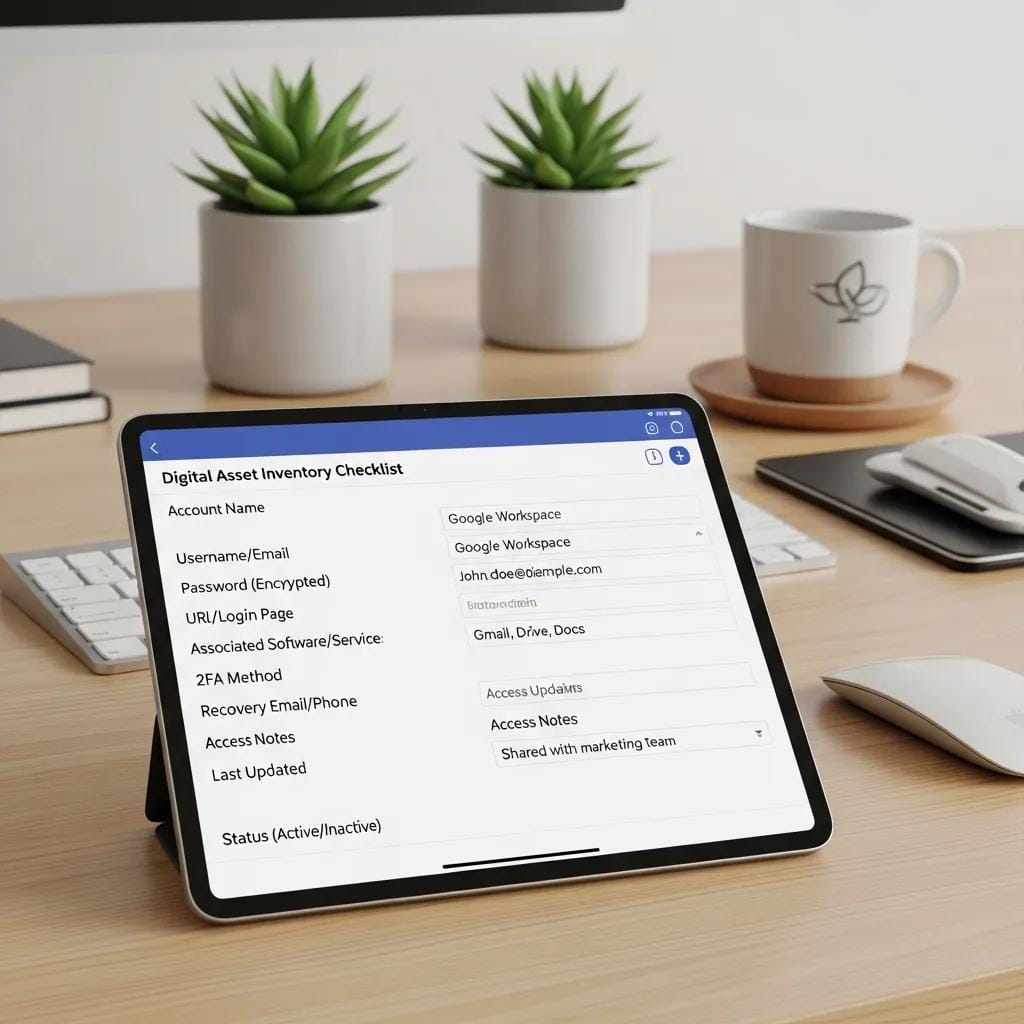
Begin your digital asset inventory with essential fields: account name, username/email, URL or platform name, custodian (self-custodial vs. custodial), access notes (password location, 2FA method), and estimated value or sentimental importance. Store this inventory in an encrypted digital vault or a sealed physical vault with clear instructions for fiduciaries; include steps for emergency access and a rotation cadence to update passwords and review accounts annually. Use categorical organization—financial, business, sentimental, intellectual property—to prioritize legal treatment and whether to include assets in a trust or will. Provide a secure mechanism for updating the inventory and designate a trusted technical backup to assist the fiduciary if needed.
- Checklist summary: capture identity, custody status, access path, value, and storage instructions to make administration efficient and compliant with Illinois procedures.
H3: How to Appoint a Digital Executor or Fiduciary in Illinois
Selecting a digital executor requires balancing technical capability, trustworthiness, and willingness to follow fiduciary duties; ideal candidates understand basic security, can manage multi-factor authentication, and will communicate transparently with beneficiaries. Legally appoint the digital fiduciary by name in your will or trust and include explicit authorization for accessing digital assets; sample clause language should specify the scope (e.g., access to accounts, authority to transfer or archive content) and reference any secure storage locations for keys or credentials. Appoint backups and define boundaries between digital duties and broader executor responsibilities to prevent conflicts. Finally, provide training or written procedures so the digital fiduciary can quickly execute duties with minimal friction.
Choosing competent fiduciaries and using clear appointment language reduces the likelihood executors need to seek court intervention under RUFADAA, which leads into asset-class-specific planning considerations.
EAV table mapping inventory items to recommended estate planning actions:
How Do Specific Digital Assets Like Cryptocurrency and Social Media Accounts Impact Your Illinois Estate Plan?
Specific asset classes differ in custody, transfer mechanics, and evidentiary needs; understanding those distinctions is crucial for drafting effective Illinois estate documents. Cryptocurrencies depend on custody model—custodial exchange accounts versus non-custodial wallets—with private keys being meronym components that control access, whereas social media accounts are subject to platform legacy tools and terms of service that often limit transferability. NFTs and metaverse assets combine token provenance with platform-specific marketplaces, so transfer may require both blockchain action and marketplace compliance. This section compares common asset types and provides planning steps, followed by a focused EAV comparison table.
Technical custody determines practical paths for transfer: custodial accounts may require provider cooperation and documentation, while non-custodial holdings rely on secure key transmission or trust ownership. The next subsections analyze legal considerations for crypto/NFTs and legacy planning for social media.H3: What Are the Legal Considerations for Cryptocurrency and NFTs in Illinois?
Cryptocurrency and NFTs raise unique legal issues: proof of ownership can be a public ledger record, but access depends on private keys or custodial account controls, and transfers may trigger tax events that affect estate reporting. Custodial accounts held by exchanges may require fiduciaries to present letters testamentary and comply with KYC policies, while non-custodial wallets depend entirely on secure key transfer methods—seed phrases are meronym parts crucial to access and must be handled via trust mechanisms or secure vaults. Valuation for estate tax and basis step-up considerations depends on valuation timing and asset type, so documenting market value at date of death and maintaining provenance records for NFTs is important. Recent Illinois consumer-protection changes reinforce the need to align ownership records and transfer instructions with statutory disclosure channels.
Given these complexities, careful drafting of trust provisions or explicit testamentary directions reduces the chance of lost value or transfer disputes, which complements social-media legacy planning covered next.
H3: How to Manage Social Media and Online Account Legacy Planning
Social media accounts require combining platform-specific legacy tools—such as memorialization settings or legacy contacts—with explicit instructions in estate documents to manage content retention, deletion, or transfer of account control. Platforms often limit content disclosure to protect third-party privacy, so wills and POAs should state user preferences (archive, delete, or transfer) and indicate whether the fiduciary may download or preserve posts and messages. Include instructions about whether private messages should remain confidential or be accessible to heirs, and anticipate provider limits that may necessitate court orders for certain content. Maintain a short list of platforms and the chosen legacy action for each account in your digital inventory to guide fiduciaries efficiently.
Using both platform tools and clear legal directions minimizes ambiguity and preserves the decedent’s wishes while complying with provider policies and Illinois statutory procedures.
Comparison EAV table for asset types (access method, custody mechanism, evidence needed, transferability, suggested planning step):
What Are the Tax and Legal Implications of Including Digital Assets in Your Illinois Estate?
Digital assets can affect federal estate tax calculations, capital gains exposure for heirs, and income reporting, so valuation and timing rules are central legal considerations. Many digital assets are included in the decedent’s gross estate at fair market value as of the date of death, which can produce estate tax consequences in larger estates and capital gains implications when heirs later sell assets like cryptocurrency. Step-up in basis rules may apply to some assets, reducing immediate capital gains tax for heirs, but valuation for unique items (NFTs, active online businesses) requires careful documentation and sometimes professional appraisal. Beyond tax, durable powers of attorney can authorize agents to manage digital assets while the principal is alive, but POA language must be drafted precisely to avoid conflicts with provider policies and RUFADAA limitations.
Understanding these tax and legal interactions helps determine whether assets should pass via trust or will, and how to craft POA clauses that balance access during incapacity without compromising security. The following subsections explain tax triggers and POA mechanics in practical terms.
H3: Will Digital Assets Affect Your Estate’s Tax Liability in Illinois?
Digital assets may increase the gross estate subject to federal estate tax and, depending on valuation and holdings, can affect state-level tax considerations; however, Illinois currently does not impose a separate estate tax, having repealed its estate tax effective January 1, 2015, so federal valuation rules primarily drive tax outcomes. Valuation for unique digital items—such as NFTs or domain names—often requires appraisal and supporting records to establish fair market value at death, which affects both estate tax and step-up basis calculations for heirs. Cryptocurrency holdings are treated like property for tax purposes, so unrealized gains may produce capital gains tax when heirs dispose of assets after receiving a stepped-up basis, if applicable. Accurate recordkeeping and early valuation reduce audit risk and help fiduciaries meet reporting responsibilities.
If valuation or tax exposure is significant, using trusts or other planning vehicles can manage liquidity and tax payment strategies without sacrificing control over digital asset disposition.
H3: How Does Power of Attorney Address Digital Asset Access?
Durable powers of attorney can authorize agents to manage digital asset access during incapacity, but POA language must expressly reference digital assets, login credentials, private keys, and any limitations to be effective under Illinois law and to be recognized by providers. Sample POA clauses should include clear authorization for the agent to access, manage, or transfer digital assets, and to interact with custodial platforms, subject to privacy considerations and any provider-specific restrictions. Providers may still insist on their own verification procedures, and RUFADAA may delineate how POAs interact with post-mortem fiduciary authority, so attorneys often recommend parallel trust or testamentary directions for after-death access. Granting broad access requires safeguards—such as limiting POA activation, specifying security protocols, and appointing backups—to protect against misuse while ensuring continuity.
Careful POA drafting minimizes the need for court intervention and helps agents act promptly during periods of incapacity, which transitions into options for obtaining professional help when planning.
Why Choose LaCava Law Firm for Your Illinois Digital Estate Planning Needs?
LaCava Law Firm focuses on estate planning and real estate in Illinois and advises clients on incorporating digital assets into wills, trusts, and powers of attorney with attention to Illinois RUFADAA and recent consumer-protection developments. The firm emphasizes tailored solutions and transparent, honest rates while offering practical assistance with inventories, fiduciary appointment language, and trust drafting to handle private keys or custodial accounts when appropriate. Clients working with LaCava receive guidance on aligning legal documents with provider requirements, preparing the documentation fiduciaries will need, and structuring secure storage plans for credentials and devices. If you prefer professional support to implement the practical steps outlined above, LaCava Law Firm can provide local Illinois legal expertise and pragmatic next steps to protect digital legacies.
H3: What Expertise Does LaCava Law Firm Offer in Digital Asset Estate Planning?
LaCava Law Firm offers estate planning services relevant to digital assets, including drafting wills and trusts with explicit digital clauses, advising on powers of attorney that address electronic access, and assisting with digital asset inventories and fiduciary appointment language. The firm provides guidance on how Illinois RUFADAA affects fiduciary access and helps clients structure documents to align with provider expectations and consumer-protection rules. LaCava positions itself as a source for tailored solutions and honest rates, focusing on client needs rather than a one-size-fits-all template. These services are intended to reduce the administrative burden on fiduciaries and preserve both financial and sentimental value in digital estates.
H3: How Does LaCava Provide Tailored and Transparent Estate Planning Solutions?
LaCava Law Firm’s client engagement follows a consultative process: an initial discussion to identify assets and goals, collaborative planning to determine whether to use trusts or POA clauses for digital assets, and document drafting that includes clear language for fiduciaries and secure-storage recommendations. The firm emphasizes transparency and honest rates in presenting options so clients understand trade-offs—such as the relative benefits of trust-based control for non-custodial private keys versus a will-based directive for custodial accounts. LaCava also assists with practical implementation steps like inventory templates and procedural checklists for fiduciaries to follow under Illinois statutes. For readers who want professional assistance, contacting LaCava Law Firm through their local business profile is the recommended next step to arrange a discussion tailored to your digital estate planning needs.
Conclusion
Incorporating digital assets into your Illinois estate plan is essential for ensuring access, preserving value, and protecting privacy. By understanding the nuances of Illinois law and following practical steps, you can effectively manage your digital legacy. Engaging with a knowledgeable estate planning attorney can streamline this process and provide tailored solutions for your unique needs. Take the first step towards safeguarding your digital assets by contacting LaCava Law Firm today.